Chances are that Maslow’s Hierarchy of Needs is not high on your inspiration list when starting a design project.
However, it may be time to give Maslow a little more thought.
However, it may be time to give Maslow a little more thought.
As designers, we often get caught up in the details of form, finish, function, interaction, and striving for a “delightful” user experience. In a crisis, those become luxuries. Looking at Maslow’s pyramid, safety makes up a significant portion of the foundation—just above basic physiological needs like food, water, and air. In a crisis such as the COVID-19 pandemic, nothing matters more than keeping people safe.
Speed matters, too.
There is no time to waste when the goal is protecting lives.
There is no time to waste when the goal is protecting lives.
To move quickly in a time of crisis, you need a tight-knit team focused on a shared objective. The conditions of the pandemic, while dire, created an environment for rapid iteration, innovation, and collaboration—even as people were physically apart. Designers and engineers across industries rose to the challenge of protecting healthcare workers. Thanks to this community of thinkers, makers, and suppliers, new variations of face shields, masks, and ventilators quickly emerged—many reaching hospitals in urgent need.
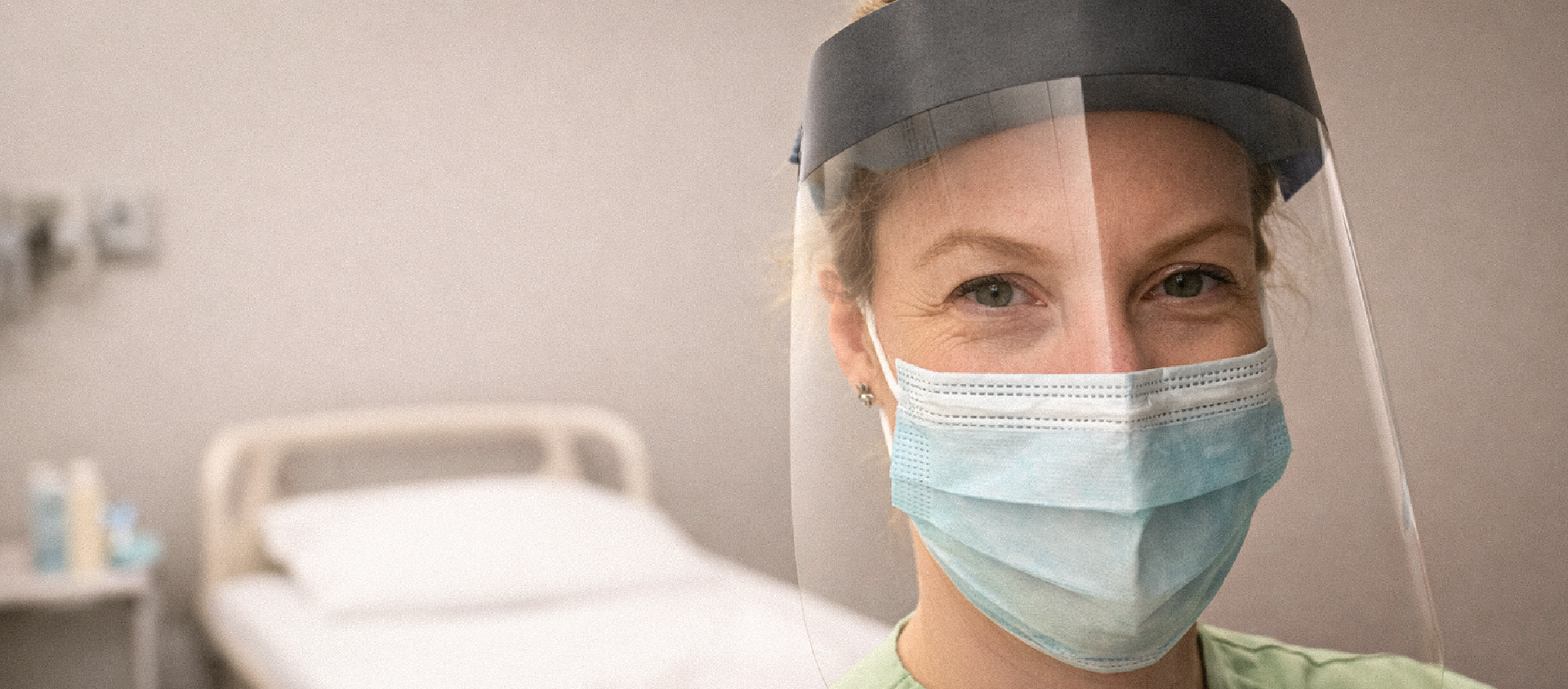
As infection rates climbed in the United States, it became clear that shortages of personal protective equipment (PPE) would put healthcare workers at serious risk. Lennon Rodgers, Director of the Grainger Engineering Design Innovation Lab at the University of Wisconsin–Madison, responded to an urgent request from UW Hospital by prototyping face shields using parts from local hardware and craft stores. To meet the hospital’s request for 1,000 units, Rodgers sought help refining and scaling the design.
Jesse Darley, Delve’s Director of Mechanical Engineering, connected with Brian Ellison of Midwest Prototyping to evolve the concept. Their goal was to simplify the design for large-scale production while improving comfort and reducing weight.
Jesse Darley, Delve’s Director of Mechanical Engineering, connected with Brian Ellison of Midwest Prototyping to evolve the concept. Their goal was to simplify the design for large-scale production while improving comfort and reducing weight.
There was no time to dwell on fine details.
This was about delivering a viable minimum product, fast.
The Badger Shield, as it became known, needed to meet hospital requirements while using materials available in large quantities. Rodgers’ wife, an anesthesiologist at UW Hospital, provided direct clinical input. Meanwhile, COVID-19 cases in Wisconsin surged—from two diagnosed patients on March 9 to more than 800 by March 27.
UW Hospital approved the shield for infection control on March 19. Rodgers shared the design publicly, posting Darley’s drawings online for others to use. Within days, the team produced more than 1,000 shields for UW Hospital staff.
With the design open sourced, adoption accelerated quickly. Local manufacturers and suppliers stepped in, and companies such as Ford Motor Company joined the effort, producing up to 100,000 shields per week. What began as a small, urgent response scaled rapidly into a broad manufacturing effort, inspiring similar initiatives nationwide.
With the design open sourced, adoption accelerated quickly. Local manufacturers and suppliers stepped in, and companies such as Ford Motor Company joined the effort, producing up to 100,000 shields per week. What began as a small, urgent response scaled rapidly into a broad manufacturing effort, inspiring similar initiatives nationwide.
After receiving the initial shipment, UW Hospital identified additional critical needs—among them, fabric hoods compatible with Powered Air Purifying Respirators (PAPR), which provide a filtered air environment around the wearer’s head.
Once again, the team moved quickly. Recognizing that elements of the face shield could inform the hood design, they began developing a cut-and-sew solution. Darley brought in Corin Frost, Delve’s Director of Visual Communications and an experienced seamstress, to lead the effort.
While Frost developed the initial pattern based on an existing PAPR hood, the team simultaneously designed a universal valve to connect with different systems. Karl Williamson at the UW Makerspace supported early prototyping by laser cutting patterns from Tyvek, a material chosen for its light weight, breathability, and availability. However, Tyvek proved difficult to sew around the face shield lens, and the team quickly identified the inefficiency of a multi-piece pattern.
Frost shifted to a one-piece approach, using muslin to prototype and refine the design. She evaluated available medical-grade materials, identified critical features, and eliminated unnecessary complexity.
Darley served as the fit model, testing prototypes on Frost’s front porch while discussing adjustments through a storm door. After each iteration was cleaned, prototypes were delivered to UW Hospital for evaluation, with testing sessions documented via phone video. The team reviewed feedback remotely each evening, iterating rapidly. Within four days, they reached version seven—a viable solution ready for production evaluation.
Ellison connected the team with Clothiers Design Source (CDS), a Minnesota-based manufacturer producing face masks. Frost shared digital patterns and instructions, and overnighted the latest prototype. The next day, the teams aligned via Zoom, transferring knowledge from prototyping to production. CDS refined the pattern and began preparing for scaled manufacturing.
Material sourcing presented the next challenge. The team activated an extended network spanning medical textile suppliers, outdoor apparel companies, and fashion manufacturers. The urgency of the situation drove rapid coordination across industries.
While speed was essential, another factor proved even more critical: trust.
While speed was essential, another factor proved even more critical: trust.
Healthcare workers needed to trust that the equipment would protect them. Equally, the design and manufacturing teams needed to trust one another to execute quickly and effectively. Generating ideas is important, but success depends on a connected community that knows how to mobilize the right expertise at the right time.
At the time of writing, production planning for an initial run of 15,000 PAPR hoods was underway. While much of the early work was supported by donated time and resources, long-term success requires sustainable economic models. Manufacturers must be able to support their workforce while meeting the demand for critical equipment.
Designers bring more than the ability to create artifacts. We are trained to identify the right problems, navigate ambiguity, and make progress without complete information. In moments of crisis, those capabilities become essential.
We are operating at the most fundamental levels of Maslow’s hierarchy today. But as the world adapts in the aftermath of COVID-19, designers will play a critical role in shaping what comes next. This moment can serve as a catalyst for meaningful and lasting change.
The path forward remains uncertain. New challenges will emerge, and new problems will need solving. What should remain constant is the willingness of the design community to come together, contribute, and act.
Stay connected. There are many people and places in need of thoughtful design at speed. Step in and make a difference.